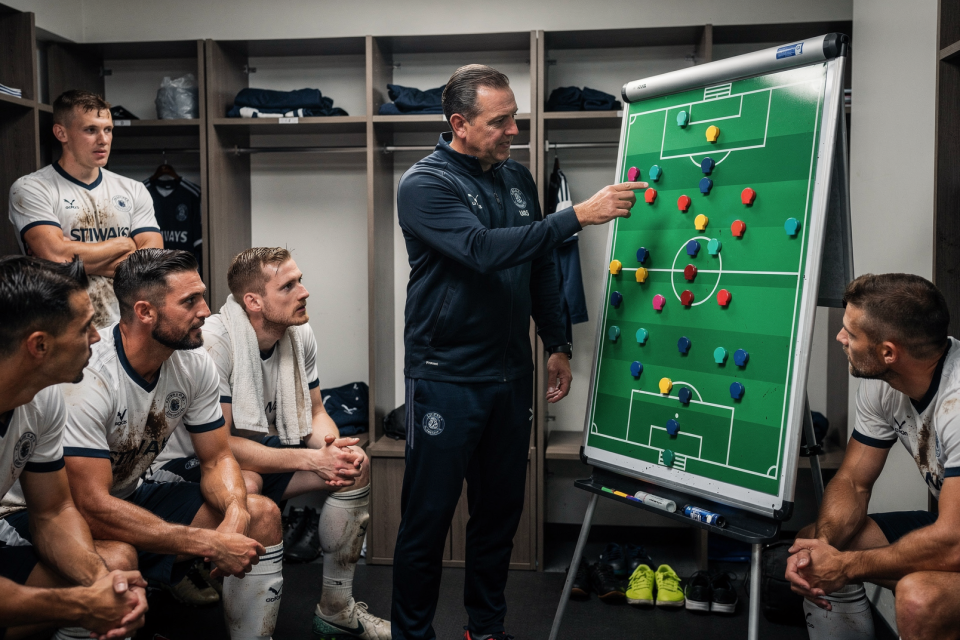
Early team news can change how a match is read long before kick-off, because one confirmed absence, return, or tactical tweak can alter both the expected shape of the game and the market reaction around it. In practice, the smartest readers use early team news not as gossip, but as a working signal: a clue about selection, strategy, fitness risk, and where the match may tilt.
Why early team news matters before a ball is kicked
Early team news matters because it changes expectations, sometimes dramatically, and often earlier than the final lineup does. It gives analysts, supporters, and bettors a first serious look at who is likely to start, who may be protected, and which tactical ideas a manager is preparing to use.
In football especially, the first credible team update can reshape the entire conversation around a fixture. A striker passed fit after a fitness scare suggests a more aggressive approach — perhaps a higher press and earlier balls into the channel. A key defender ruled out, by contrast, often forces a deeper defensive line and a more hesitant build-up. That is why early team news is never just about names. It is about roles, patterns, and the likely balance of a contest.
For a publication like PrimeView Chronicle, this is also where the story begins to move from raw information to interpretation. The news itself is only the surface. The useful part is what that news implies about structure, momentum, and match rhythm. A team may still “have” its star players on paper, but the version of the side that actually takes the field can look very different once you account for who is carrying a knock, who is being shielded for a bigger fixture, and who has been drafted into an unfamiliar role.
| Early team news signal | What it usually changes | What readers should ask |
|---|---|---|
| Star attacker doubts | Chance creation, pressing intensity, finishing threat | Who replaces the output, not just the name? |
| Centre-back ruled out | Defensive line height, set-piece vulnerability, build-up security | Does the replacement alter the whole back line rhythm? |
| Midfield return | Control, tempo, pressing resistance | Will the manager trust the player for 90 minutes? |
| Full-back fitness issue | Width, overlap patterns, defensive exposure | Is the side losing balance on one flank? |
| Late illness in the squad | Rotation, bench strength, tactical caution | Does the starting XI become more conservative by default? |
The key point is simple: early team news should be read as a forecast, not a verdict. It rarely tells the full story, but it often tells enough to adjust your expectations before the official teams land — and that head start matters enormously when you are trying to understand where a match might be won or lost.
How to read early team news without overreacting
The best way to read early team news is to separate confirmed information from educated noise. Not every update deserves the same weight, and not every “doubt” means the player is out. Jumping at every training-ground whisper is a quick path to misreading a fixture entirely.
A useful rule is to ask three questions each time a fresh update appears. First, how credible is the source? A club correspondent with direct access carries far more weight than a second-hand social media aggregation. Second, how close is the report to kick-off? A Tuesday rumour about a Saturday match has less predictive value than a Friday afternoon briefing. Third, does the update change the team’s structure or just its personnel? A minor knock to a rotation player matters less than a late change involving the goalkeeper, central defenders, or the main creator — those are the roles where a single alteration can force a whole system to recalibrate.
There is also a timing issue. Early team news often arrives in stages: training observations, local reporting, pre-match press conference hints, then the final line-up. Each stage narrows the possibilities. The mistake many people make is treating the first stage as final truth. It usually is not. It is the first piece of a puzzle, and sometimes the wrong piece gets amplified because it is the most dramatic version available.
Another common error is assuming that “available” means “fully fit.” Managers do not always describe fitness in absolute terms, and they have little incentive to be completely transparent. A player may be on the squad list but not capable of the same intensity, especially in a congested schedule where repeated sprints and counter-press demands punish anything less than full sharpness. That matters because football is not just about whether a player can start; it is about whether that player can sustain the demands of pressing, tracking, and recovering across 70-plus high-intensity actions. A half-fit creator can become a defensive liability even while offering moments of quality on the ball.
A practical reading method is to focus on impact per position rather than reputation alone. A backup winger missing the match may barely move expectations. A missing holding midfielder, however, can alter the whole defensive rest shape — suddenly the back line drops deeper, the press becomes less coordinated, and opponents find more room between the lines. In other words, early team news should be judged by tactical leverage, not headlines.
- Check whether the report names a player as doubtful, unlikely, or ruled out — these distinctions carry different levels of certainty.
- Compare the update with the team’s recent usage: has the player been starting regularly, or only rotating in specific matchups?
- Look at the likely replacement and ask whether the replacement changes style, not just quality. A less technically gifted deputy might actually suit a more direct, compact game plan.
The more you do that, the less likely you are to chase every rumour as if it were a confirmed team sheet — and the better your pre-match read becomes.
What early team news usually tells us about tactics
This is where early team news becomes genuinely valuable for match analysis. If a manager is weighing up whether a key midfielder can start, that decision affects more than the midfield. It may influence the width of the attack, the protection in transition, and the way full-backs are asked to position themselves. A missing tempo-setter, for instance, often means the full-backs stay deeper because there is less security against counter-attacks through the centre. Likewise, a surprise return for a direct runner can suggest a more vertical game than expected — longer passes, earlier crosses, and a heightened emphasis on second balls. The absence of a creative midfielder, meanwhile, often indicates a more reactive approach: deeper blocks, less ambition in possession, and a reliance on set-piece moments.
The tactical value of early team news is often clearest when a team is already under pressure. A manager facing a poor run may respond by simplifying the structure: fewer risks in possession, deeper defensive spacing, and a stronger emphasis on set pieces. Early team news can hint at that before the first whistle, especially if the likely XI includes extra defensive cover or fewer natural creators than the squad list would suggest. You start to see the shape of a team that is trying to stop the bleeding rather than impose itself.
It also helps explain why two teams with similar raw quality can produce very different match expectations. One team may have its full spine available — goalkeeper, centre-backs, holding midfielder, striker — and be ready to dominate territory. The other may be forced into patchwork decisions, like a full-back at centre-half or a winger operating as a false nine. On the page, both are still the same clubs. In practice, they may not play like the same versions of themselves at all.
| Team news pattern | Likely tactical meaning | Match-analysis implication |
|---|---|---|
| Extra centre-back in the squad | Defensive insurance or back-three flexibility | Expect lower risk and deeper rest defence; transition moments may be fewer |
| Fit-again playmaker starting | More central progression and final-third invention | Chance creation may rise, but pressing work may drop if match fitness is fragile |
| No natural striker available | More fluid front line or false-nine use | Expect different box occupation and less direct finishing; wingers may cut inside more |
| First-choice holding midfielder absent | Greater exposure in transition | Opponent may press higher and attack central zones with earlier vertical passes |
| Full-strength back line named early | Confidence in control and structure | The team may push higher up the pitch and squeeze the game in the opponent’s half |
The subtle point is that early team news is not just a list of absences. It is a map of likely decisions — a window into how the manager sees the fixture. That is why analysts pay attention to it well before the final lineup graphic appears on screen.
How teams, clubs, and analysts should use early team news
For clubs and analysts, the practical value is obvious. A credible injury update changes training loads, substitution planning, and opposition prep in concrete ways. If a key player is genuinely at risk, staff can adjust the starting plan and think more carefully about when to introduce them — perhaps targeting a 30-minute cameo rather than a full 90-minute shift. If the opposition is expected to miss a ball-progressing centre-back, pressing triggers can be adjusted to exploit that weakness early: higher pressure on the receiving midfielder, forcing the less comfortable defender into difficult distribution.
For journalists and editors, early team news is the moment to shift from reporting to framing. The update should be translated into what it means, not simply repeated. A clean report tells readers who is likely in or out. A stronger report explains why that matters and what it may change on the pitch — how the defensive line might drop, how the attacking patterns might narrow, how the bench options suddenly look thinner in a crucial phase of the match. That is a major difference, and it is where match analysis earns its value with an audience that wants understanding, not just information.
For fans, the most useful habit is to compare early team news with the manager’s recent patterns. Some coaches are highly predictable and make only one or two changes within a settled system. Others use late surprises to keep opponents guessing — a tactical tool in itself. A team news update means more when it fits a pattern you already understand. If a manager has recently favoured cautious away setups, a defensive inclusion is less surprising than it looks, and the formation may already be tilted toward containment rather than control.
A simple pre-match checklist helps keep expectations grounded:
- Identify the core players whose availability changes shape, not just quality — the spine players around whom the system is built.
- Compare early news with the likely tactical formation and ask whether the pieces still fit the same way.
- Watch for replacements who alter pace, width, or pressing intensity — a change in profile often matters more than a change in name.
- Treat uncertainty as part of the story, not a reason to overstate confidence. A doubt is precisely that: a doubt.
Common mistakes when reacting to early team news
The biggest mistake is assuming that a single update tells the whole story. It rarely does. A player can be “rested” for tactical reasons, “managed” because of fitness, or omitted because the staff want to protect them for a heavier fixture around the corner. Those scenarios look similar at first glance — a big name missing from the predicted XI — but they mean different things for the match ahead. A rested player might return sharper next week; a managed player might still feature off the bench; a protected player signals that the manager is prioritising a different contest entirely.
Another frequent error is overvaluing the headline name and undervaluing the replacement. A squad loss can be softened, sometimes even neutralised, if the deputy suits the match plan better. A less famous player may actually improve the collective shape if they provide the exact profile the manager wants — a more disciplined defender, a more direct runner, a midfielder who stays positionally compact. That is one reason raw name-based reactions often fail. Football is a chain of interactions, not a roll call of individuals, and the unit often functions differently with a different component even if the star power looks reduced.
There is also a timing trap. Early team news that arrives too close to kick-off may be more reliable, but it is also easier to distort if people ignore earlier context. A player reported as doubtful all week is not the same as a player suddenly pulled after the warm-up — the former was already factored into the team’s preparation, the latter is a genuine disruption. The market, the press, and the fanbase can react very differently to those two scenarios, even if the final consequence on the pitch — a missing starter — looks superficially similar.
A third mistake is confusing tactical adaptation with weakness. When a side loses a key attacker, the obvious assumption is that they will be worse. Sometimes they are simply different. They may become narrower, more compact, and harder to counter. That may reduce their attacking ceiling, but it can also make them more stubborn and hard to beat. Early team news should be used to identify the shape of the match, not just to grade the star power of each lineup like a video-game rating.
The easiest way to avoid these errors is to stay specific. Ask what changes in the build-up, what changes in transition, and what changes in the final third. If the answer is “not much,” then the team news probably should not move your expectations much either. If the answer is “quite a lot,” then the update deserves serious attention and a recalibrated view of how the match will unfold.
Reading early team news in the wider match-analysis cycle
Early team news is most valuable when it sits inside a wider analysis process. On its own, it is incomplete — a fragment of the picture. Combined with form, style, and matchup data, it becomes much more powerful and much harder to misread.
Think of the process in layers. First comes the basic fixture context: competition, venue, schedule pressure, and recent workload. A midweek Champions League away trip changes everything about a Saturday lunchtime kick-off. Then comes team news: who is likely available, who is doubtful, and who may be managed carefully. After that comes tactical comparison: where each side creates chance volume, how each defends space, and where mismatches may appear — perhaps a high-line defence facing a speed merchant on the counter, or a pressing-heavy midfield against a team that struggles to play through pressure. Only then does the final picture become useful enough to form a solid pre-match expectation.
This layered approach is especially helpful in British football coverage, where fixture congestion and squad rotation often matter as much as form. A team coming off a midweek match may look “strong” on paper but still choose a conservative selection because legs are heavy and the risk of soft-tissue injuries is real. Likewise, a club with a genuinely deep bench may absorb absences better than the headlines suggest. The raw headline — “Star midfielder a doubt” — is less important than the context behind it: whether the replacement is a like-for-like profile or a completely different tactical option.
That is also why early team news should be treated as part of a living narrative. The story changes as more information arrives. A doubtful starter becomes a late fitness test. A bench inclusion becomes a start. A tactical guess becomes a confirmed setup. Good match analysis follows those changes without pretending that the first version of the story was complete — it updates the picture incrementally and explains what each fresh piece of information actually shifts.
The most effective coverage does two things at once: it informs quickly and explains carefully. Readers want to know who is in and out, but they also want to understand what that means for how the game may unfold — whether a fixture is trending toward chaos or control, openness or tight margins. Early team news gives the opening frame. Analysis fills in the picture, stroke by stroke.
Practical ways to use early team news before kick-off
Start with the likely baseline: recent form, style, and usual structure. What has this team looked like over the past three or four matches? Is the identity consistent or shifting week to week? Add early team news only when it changes a key role or a key zone — if the goalkeeper, central defensive pairing, holding midfielder, or main goal threat is affected. If it is a fringe adjustment, the baseline holds. Once the news settles, reassess the match in terms of control, transition, width, and set pieces — those are the areas most sensitive to personnel changes. Then update your expectation again when the official lineups are released, because that final confirmation sometimes corrects or sharpens the earlier signals.
That workflow keeps the reaction disciplined. It prevents the common habit of swinging from overconfidence to panic every time a new report surfaces on social media. It also makes the analysis more useful, because each update is tied to a football reason — a structural change, a shift in pressing capacity, a different profile in a crucial position — rather than a purely emotional reaction to a name dropping out of the predicted XI.
Long before the first tackle, you can often sense whether a contest will be open or tight, direct or controlled, familiar or improvised. Early team news is often the first place where that shape becomes visible. A side missing its first-choice holding midfielder and playing away is likely to sit deeper, concede territory, and look for moments on the break. A full-strength home side with a returning playmaker is likely to dominate the ball and probe for openings. Those contours emerge from the early information if you know where to look — and that is the sort of signal serious match analysis should learn to spot early.
If the update changes a team’s spine — goalkeeper, centre-back, defensive midfielder, centre-forward — the expectation changes with it. If it only affects a fringe role, the change may be small enough to ignore. Between those two extremes lies the useful middle ground: the space where early team news turns into genuine insight, where the fixture stops looking like a static preview and starts looking like a contest already in motion.