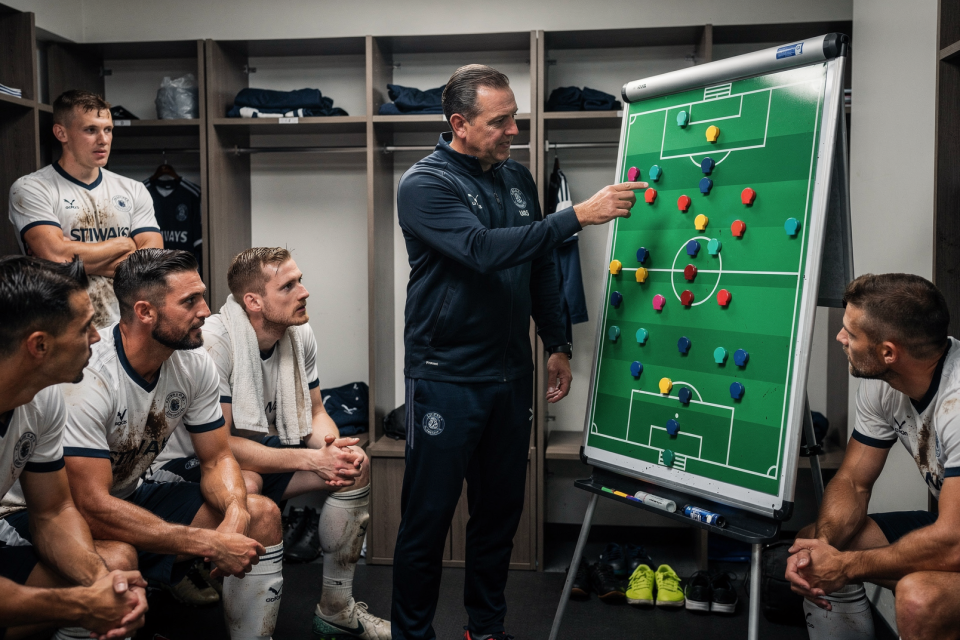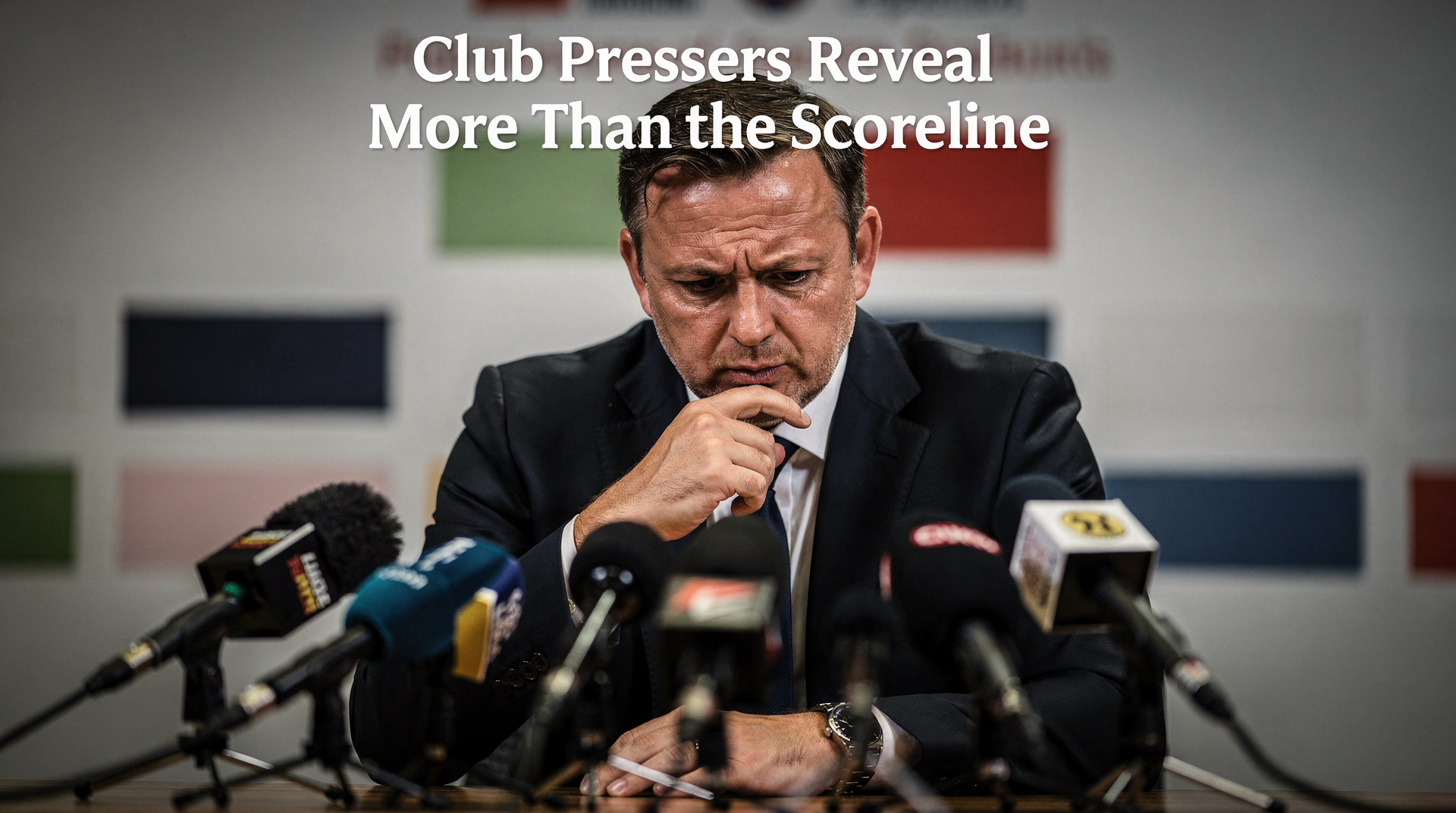
Most people treat the pre-match press conference as background noise — something to skim while waiting for the real information to drop. That instinct misses something crucial. The club presser, when you learn to read its rhythms and ruptures, is often more revealing than the ninety minutes that follow. It exposes vulnerability before a ball is kicked, signals tactical intent that hasn’t yet appeared on a tactics board, and lays bare the psychological state of a dressing room that would otherwise stay hidden. In the UK football landscape, where the media cycle spins faster than most, the press conference remains one of the few moments when a club must speak publicly with some degree of accountability. The trick is knowing where to look.
Why club pressers matter more than many fans think
Club press conferences are not just media theatre, though they certainly contain elements of performance. They are one of the most useful public windows into a team’s state of mind, selection plans, and priorities. A manager might not tell you outright that the left-back is carrying a hamstring concern, but the way they hesitate, qualify, or redirect tells you everything you need to know. They reveal what a manager is trying to protect, what they are quietly preparing, and where the club wants the narrative to go before a match. For analysts, reporters, and serious fans, the challenge is not hearing the answers — it is learning how to read the gaps between them.
That skill matters because a press conference is rarely a simple Q&A. It operates as a controlled information environment, and the control itself is informative. Take the tactical presser before a high-stakes derby: if a manager suddenly becomes expansive about pressing triggers, detailing how the front three will hunt in specific zones, that usually means the staff are comfortable with the tactical direction and have drilled it thoroughly enough to discuss openly. If they become unusually evasive about a forward’s availability — deflecting with “we’ll see” or pivoting to the collective — the absence of detail is often as valuable as the detail itself. The press conference exists in that strange space between communication, concealment, and strategic positioning. The manager is talking to the room but also to the opposition analyst, the club’s own players, and sometimes the board.
For a publication like PrimeView Chronicle, that is exactly where the real story begins. The scoreline tells you what happened — the bare result, the numbers, the outcome that gets clipped and shared. The press conference often tells you why it happened, or what the club believes will matter next. It provides the reasoning that connects selection decisions to tactical execution, or sometimes the rationalisation that papers over cracks the match will later expose. The art lies in discerning which one you’re hearing.
| What a press conference can reveal | Why it matters | How to use it |
|---|---|---|
| Injury status | Changes team shape and selection | Compare phrasing across questions and days |
| Tactical intent | Signals pressing, build-up, or rotation plans | Match comments to recent on-pitch patterns |
| Squad morale | Shows confidence, tension, or caution | Watch for repeated emotional cues |
| Media strategy | Indicates what the club wants to emphasise | Separate information from framing |
| Managerial priorities | Shows which competition or opponent is being targeted | Note where the longest answers go |
The key point is simple and bears repeating: club pressers are a form of evidence. Not perfect evidence — every manager has told a half-truth or deployed a convenient omission when it suited them — not complete evidence, but evidence all the same. The discipline is treating them as one input among many, a piece of the puzzle rather than the finished picture.
What managers actually tell you when they say very little
A short answer is often the loudest answer in the room. When a manager refuses to expand on fitness, selection, or tactics — offering clipped responses, steering to generalities, or shutting down a line of questioning entirely — that silence usually points to one of three things: uncertainty, gamesmanship, or internal sensitivity. Each category reveals something different, and learning to distinguish them is half the analytical work.
The first category is straightforward, though often misread as deliberate concealment. Sometimes the manager genuinely does not know whether a player will pass a late fitness test. In those cases, the vague language is practical rather than evasive. Phrases such as “we’ll assess him tomorrow” or “he’s making progress” usually mean the medical and coaching staff are still waiting on a final call — perhaps a morning scan, a reaction to training load, or simply how the player feels when they wake up. That can help analysts predict line-up risk, especially in congested UK fixture periods where recovery time between matches shrinks to seventy-two hours or less. The Boxing Day presser, for instance, often carries more genuine medical uncertainty than tactical deception.
The second category is tactical concealment, and this is where the professional game sharpens its edge. Managers do not want to hand opponents an easy advantage, especially before a derby, a cup tie, or any match where one tactical tweak could decide the outcome. If a coach suddenly stops discussing full-back positioning, set-piece routines, or whether a midfielder will play deeper — topics they addressed freely in previous weeks — there is often a calculated reason. Sometimes that reason is as simple as not wanting to confirm a shape that the opponent might exploit. Sometimes it is about forcing the opposition to prepare for multiple possibilities, keeping them guessing until the team sheet lands. The silence is deliberate, and the deliberate silence itself becomes a signal: something specific is being protected because it matters.
The third category is internal sensitivity, and this is where press conferences become genuinely revealing in ways that extend beyond the pitch. If a manager deflects questions about a player’s attitude, contract situation, or disciplinary matter, the issue may be larger than the public version suggests. Clubs rarely admit this directly — the PR machinery is too sophisticated for that — but the wording gives them away. A repeated “he is focused on training” can be a useful clue that the real story is not tactical at all but personal, contractual, or political. The careful language wraps the tension in professionalism, but it cannot fully disguise it.
Just as important, pressers also reveal what managers consider worth protecting. If a coach is willing to discuss the midfield structure in granular detail but deflects every question about the goalkeeper’s status, that tells you where the vulnerability sits. If they happily talk about “energy” and “intensity” — the safe, motivational vocabulary — but avoid direct discussion of rest defence, it may suggest a more fragile balance in transition than the club wants to admit publicly. The protection tells you where the cracks might be.
The language patterns that usually matter
Certain phrases appear so often in press conferences that they can seem meaningless, drained of content by repetition. In practice, they are useful markers once you learn to decode them. The manager is speaking in a kind of shorthand that the experienced listener can translate.
- “We need to be aggressive” often points to a team expecting to press higher or start faster — it signals intent to impose rather than react. When you hear this in a pre-match presser, watch the opening ten minutes for a coordinated press rather than passive shape.
- “We have to manage the game better” usually follows recent lapses in control, not just poor finishing. This phrase often surfaces after a match where the team surrendered a lead or lost composure in key moments, and it hints that the coaching staff have identified game management as the priority fix.
- “He trained with us” is more informative than “he is available”, because it leaves room for doubt. Training participation doesn’t guarantee match fitness, and the careful phrasing keeps options open while satisfying the media’s demand for an update.
- “We’ll see tomorrow” often means the decision is not final, especially for players returning from muscle injuries. The medical staff want one more look, one more data point, before committing to a bench spot or a start.
- “The group is in a good place” can be genuine, but when repeated after poor results — and especially when delivered with a flat tone — it may function as reassurance rather than fact. It’s the verbal equivalent of a club putting out a statement of support for a manager: the words say stability, but the context may suggest otherwise.
The best analysts do not read these phrases in isolation. They compare them with previous weeks, team news, substitution patterns, and the club’s on-field behaviour. That is where the picture sharpens. A single “we need to be aggressive” might mean nothing. The same phrase appearing for three consecutive pressers, paired with increasingly urgent body language and a pattern of slow starts, tells a very different story.
How to read a club presser like an analyst, not a headline chaser
The most reliable way to interpret a presser is to separate three elements: content, tone, and omissions. Content tells you what was said — the words chosen, the facts acknowledged, the subjects engaged. Tone tells you how it was said — the register, the emotional temperature, the body language that accompanies the words. Omissions tell you what the club did not want to say at all, and this third element is where the sharpest analysis often lives.
Start with the obvious: who asked the question, and why was that question asked now? A reporter following up on a full-back’s workload is usually reacting to something visible in the previous match or training ground reports — a late substitution, a visible fatigue drop-off, a pattern of being targeted by opponents. A question about mentality after a poor away performance is usually a clue that the club knows the issue is not purely technical; something in the dressing room or the psychological preparation has drawn attention. If the press conference repeatedly circles the same topic — three, four, five variations on the same concern — it often means that topic is the real news, even if the answer remains neat and polished. The room knows what matters, even when the manager pretends otherwise.
Tone matters because managers rarely speak in the same register every week, and the shifts are diagnostic. Calm, detailed answers can signal genuine confidence, but they can also indicate that the club has settled on a consistent message and will not deviate regardless of provocation. Sharper responses may suggest frustration — with injuries, with the board, with a specific player — while shorter, clipped replies can reveal that a subject has become politically sensitive. Between the lines, the emotional temperature often changes before the tactical structure does. I’ve watched pressers where the manager’s tone shifted weeks before the team’s shape changed, as if the mood was the earliest signal of a deeper adjustment.
Omissions are the most undervalued clue of all. If the manager spends five minutes dissecting the opponent’s strengths — their pressing triggers, their set-piece routines, their transition speed — but barely mentions their own attacking patterns, that silence may indicate genuine uncertainty about their own front line. If they are unusually specific about one player’s recovery timeline but not another’s, that asymmetry can point to different fitness levels, different levels of risk tolerance, or a hierarchy of importance that the club would never state directly. Between the lines, the club is constantly sorting what can be said publicly and what must stay inside the building. The omitted material is the shadow story.
A useful method is to treat the press conference as a comparison document — not as a standalone event but as one text to be read against others. Compare it with:
- the previous week’s comments
- the actual match plan that unfolds
- the team sheet when it drops
- post-match comments after the result
- training-ground availability reports and images
That comparison often reveals whether a club has been honest, cautious, inconsistent, or strategically misleading. And, frankly, that is where the value lies — not in the presser itself, but in the gap between what was said and what actually happened.
| Signal in the presser | Likely meaning | What to check next |
|---|---|---|
| Repeated fitness caution | Late decision or recurrence risk | Training images, bench selection, pre-match updates |
| Detailed tactical talk | Confidence in a game plan | Look for matching structure in the first 15 minutes |
| Defensive tone on transfers | Ongoing squad tension | Watch minutes distribution and post-window comments |
| Praise for “energy” or “character” | Possible need to reset mood | Compare with recent results and body language |
| Avoidance of one player’s name | Sensitive injury, dispute, or uncertainty | Track whether that player disappears from squad lists |
There is a practical edge here as well. Broadcasters, journalists, and even fans use pressers to predict how a match may unfold — which team will start fast, who might be missing, whether the approach will be cautious or aggressive. But the better, subtler use is this: use the presser to test whether the club’s public story aligns with the football they are actually playing. That alignment check is more valuable than any single quote.
The tactical clues hidden in plain sight
Press conferences often reveal more about tactics than managers intend, especially when a coach is trying to frame the next match in a particular way. The trick is to listen for structure, not just for named positions. Listen for relationships, patterns, and priorities — not just the vocabulary of formations.
When a manager says the opponent “overloads the half-spaces”, that is not just jargon for show. It usually means the staff have identified a central issue with compactness and defensive spacing — an opponent that likes to drag centre-backs wide and exploit the channels between full-back and centre-half. When they talk about “protecting transitions”, they are telling you the team is concerned about losing the ball in dangerous areas and being exposed before the defensive block is set. These phrases are not decorative; they are tactical priorities dressed as media-friendly language, and they map directly onto the concerns the coaching staff will have addressed during the week.
The same goes for attacking comments. If a manager emphasises “getting width early”, you can expect full-backs, wingers, or even wide centre-backs to matter more than usual — the attacking shape will likely stretch the opponent horizontally in the first phase. If they keep returning to “finding the number 10 between the lines”, they are likely planning to break pressure through central pockets rather than through direct play, relying on a creative midfielder to receive on the half-turn and unlock a compact defence. In the Premier League and the Championship especially, where tactical detail is thoroughly scouted, these small cues often line up with actual match behaviour. I’ve tracked this connection over multiple seasons, and the correlation between specific pre-match language and first-half tactical patterns is stronger than many casual observers realise.
This is where a press conference becomes especially useful for pre-match analysis. A cautious, possession-heavy team may suddenly sound more direct if the opposition presses man-to-man and the manager has decided the build-up risk isn’t worth it. A counter-attacking side may stress “control” when they expect to face more of the ball against a weaker opponent who will sit deep. In the UK, where weather, pitch condition, fixture load, and opponent style all affect game plans, the manager’s language often reflects immediate context more than grand philosophy. The pragmatist reveals himself in the details.
There is, however, a limit. Coaches know that analysts listen closely, so they sometimes speak in broad terms to hide specifics — the tactical equivalent of answering a question about a player’s fitness with “we’ll assess him tomorrow”. That means the best reading comes from patterns rather than isolated quotes. If a manager repeatedly emphasises “rest defence” and “compactness” over several weeks, then a more conservative block is probably becoming the default, not just a one-off adjustment. If they start talking more about “verticality” and “second balls”, the team may be shifting toward a more direct attacking model that prioritises territory and duels over patient buildup. The pattern is the signal; the individual quote is just noise.
Here is a simple, grounded method for using tactical language without over-reading it:
- Identify the repeated phrase — the term that keeps surfacing across multiple answers.
- Translate it into concrete football terms — what does “compactness” actually mean for the defensive line, the midfield spacing, the pressing triggers?
- Match it against previous performances — did the recent match show evidence of this emphasis?
- Check whether the first phase of the next match confirms it — the opening fifteen minutes often reveal the game plan more honestly than the full ninety.
- Update the interpretation if the match shows something different — flexibility is the analyst’s friend.
That process keeps analysis grounded in evidence. Otherwise, there is a risk of turning every phrase into a grand theory, which is where a lot of lazy punditry begins — treating a manager’s offhand comment about “intensity” as a manifesto rather than a mood.
Why press conferences shape the story beyond the pitch
A club presser does not just explain the match; it helps define how the match will be remembered. That is especially true in the UK, where coverage moves fast from one fixture to the next and narrative can harden before the final whistle has even faded. The post-match analysis often begins not with the match itself but with the pre-match framing — and the press conference sets that frame.
Managers use press conferences to set expectations, and this is a skill that the best of them have refined over years. If a team is under pressure — poor results, fan discontent, media speculation about the manager’s future — the language may shift toward patience, process, and improvement. “We’re building something,” they might say, or “the signs are there.” If results have gone well, the same coach may talk about humility, consistency, and standards — dampening expectations to prevent complacency. Those shifts are not random. They are part of the club’s deliberate effort to control public interpretation of form, momentum, and confidence. The narrative management is as strategic as the team selection.
This matters because sports audiences do not consume football in a vacuum. They consume it through headlines, clips, social posts, and short post-match summaries — fragments that are easily shaped by the framing established in the presser. The club press conference becomes a bridge between internal reality and public perception. It can soften criticism before a difficult away trip, redirect attention from a contract dispute to a youth prospect, or build a storyline of resilience that will carry into the weekend’s coverage regardless of what happens on the pitch.
It can also influence how people judge individuals, sometimes in ways that outlast the actual performances. A player returning from injury might be framed as “ahead of schedule”, which creates optimism even if the return date remains uncertain and the player is still weeks from match sharpness. A winger who has fallen out of favour may be described as “working hard in training”, which sounds positive but can also signal limited opportunity — the praise is genuine, but it is being deployed because there is little else to say. Likewise, a manager facing scrutiny might receive wording that suggests stability — “full backing of the board” — even when pressure is rising behind the scenes and conversations about succession are already happening quietly.
For journalists and analysts, this is where discipline matters. Do not confuse narrative control with truth. A polished answer is still only one layer of the story, and sometimes it’s the layer the club wants you to stop at. The real task is to ask whether the club’s framing holds up once the football starts. Does the “positive week in training” produce a sharper press? Does the “nothing to report on injuries” claim match the bench when the team sheet lands? Does the “we want to be more aggressive” line lead to actual sustained pressing, or just a burst of intensity for ten minutes before the team drops into a passive block? The gap between messaging and match behaviour is often where the most useful analysis lives — and it’s the gap that rewards patient, attentive watching.
Typical mistakes readers make when they interpret pressers
The common errors are predictable because press conferences feel direct and transparent, but they are anything but. Recognising these mistakes is the first step toward avoiding them.
- Taking every quote literally instead of reading the function of the answer — asking what the manager is doing by saying this, not just what the words mean.
- Treating one comment as proof rather than comparing it with past remarks — a single quote is a snapshot, not a documentary.
- Ignoring the difference between tactical language and media language — some phrases are for the analysts, others are for the back pages.
- Assuming confidence equals honesty — a manager can sound supremely assured while delivering a version of events that conveniently omits key details.
- Overreacting to a single omission without checking broader context — not every missing name signals a crisis; sometimes the manager simply wasn’t asked.
These mistakes are common because press conferences feel direct. The manager is sitting there, answering questions, making eye contact. In reality, they are highly managed spaces where every word has been considered, or at least conditioned by years of media training and club protocols. Understanding them requires patience, pattern recognition, and a willingness to hold multiple possibilities in mind simultaneously.
How PrimeView Chronicle can turn pressers into stronger coverage
For a publication like PrimeView Chronicle, club pressers are not a standalone content type — a quick transcript to publish and forget. They are a starting point for richer match analysis, clearer opinion, and better storytelling. The best coverage uses the press conference to ask the next question, not to stop at the first answer. It treats the presser as the beginning of an analytical thread, not the end of one.
A strong workflow starts before the presser even happens. Identify the key match angles: injury doubts, potential tactical changes, rival pressure, schedule congestion, or a manager under scrutiny. Know what you’re listening for before the microphones go live. Then listen for what is said, what is avoided, and what is repeated — the three layers we’ve been discussing. After that, connect the language to the match itself. If a manager spoke about “protecting the centre”, was the midfield structure actually tighter when the game unfolded? If they emphasised “more control”, did the team reduce chaotic transitions or simply keep the ball without threat — possession as an end rather than a means? The match provides the evidence that tests the presser’s claims.
This approach also improves long-form writing. A press conference can become the opening scene of a broader piece about a club’s evolution — the moment when a manager first signalled a tactical shift, or when the language around a player began to change subtly before a transfer window opened. It can anchor a narrative about a manager’s changing priorities across a season, or trace a player’s recovery arc from cautious “he’s making progress” updates to confident declarations of readiness. In other words, the presser can provide the narrative hinge — not just the pre-match quote to fill space.
The most effective coverage usually does three things well, and these are worth treating as principles:
- It translates jargon into plain football language. “Half-space overloads” becomes “they like to attack the channels between centre-back and full-back.” The meaning stays precise but becomes accessible.
- It connects public comments to what happens on the pitch. The quote is not the endpoint; it’s a hypothesis that the match will test.
- It resists the temptation to treat media theatre as final truth. A presser is a performance, however informative, and the analyst’s job is to see through the performance to the underlying reality — or at least to mark clearly where the performance and reality diverge.
That combination is especially valuable in modern UK sports coverage, where audiences want speed but also want depth. They do not just want to know who was fit and who wasn’t. They want to know why the manager sounded cautious, why the shape shifted without warning, and what that may mean next week when the fixture list tightens. Club pressers are one of the rare moments when all those threads are visible at once — the tactical, the psychological, the political, and the narrative — if you know how to look.
The real advantage, then, is not exclusive access. Anyone with a press pass or a streaming link can quote the manager. The stronger work is recognising when a short answer hides a tactical clue, when a long answer signals a problem rather than solving one, and when the press conference is quietly telling you the next story before the scoreboard does. That skill — patient, pattern-based, suspicious of easy answers — is what separates genuine analysis from mere transcription. And in a media environment that rewards speed above all else, it is also what gives coverage lasting value.