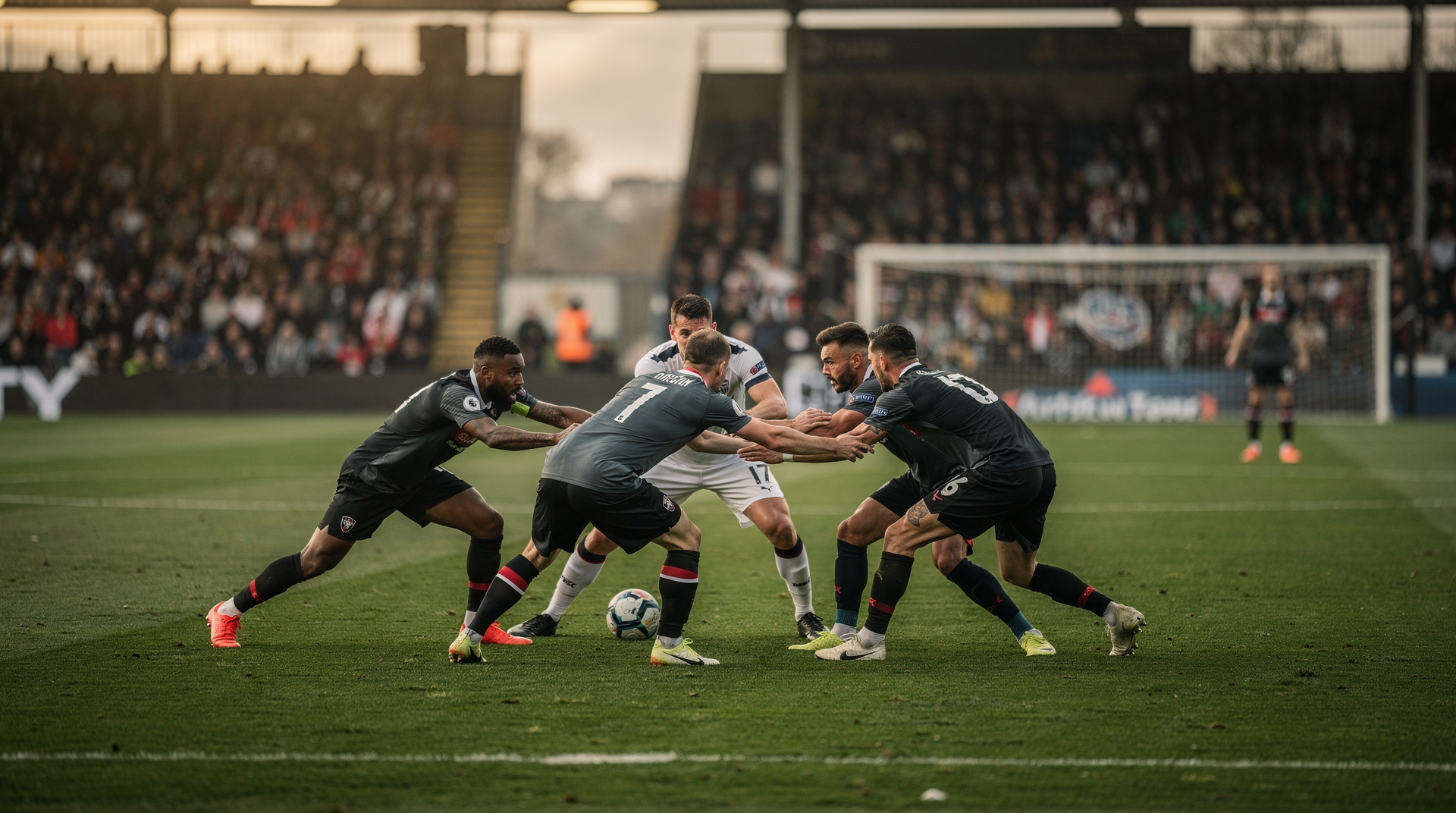
Modern defending no longer begins on the edge of the penalty area—it starts where the opponent first tries to build. The best sides in Britain and across Europe now treat the front foot as the first line of protection, using coordinated traps, cover shadows, and selective pressing to win the ball early and snuff out danger before it has a chance to become a cross, a shot, or a scramble in the six-yard box. This shift isn’t about fashion; it’s about controlling space before it becomes chaos.
Why defending has moved higher
It is almost always easier to prevent an attack from becoming dangerous than it is to survive one at the edge of your own area. Pressing early lets a team force rushed passes, shut off passing angles, and recover the ball in zones where one mistake can turn directly into a scoring chance. That is the fundamental arithmetic that has pushed defensive lines higher.
The shift is also a tactical response to how football has evolved. Build-up play is now meticulously structured, goalkeepers are more involved as distributors, and many sides deliberately invite pressure so they can beat it with a spare man. If you wait too deep, you cede time for them to scan, organise, and attack with rhythm. Defending higher compresses the pitch and forces the opponent to solve problems faster than they want—often in areas where the sideline becomes an extra defender.
There is a brutally practical reason top managers love it, too. Winning the ball 35 metres from goal is exponentially more valuable than winning it on the edge of your own box. That regain creates a shorter path to goal—often against a defence that hasn’t had time to reset—and can decide whether a team spends 30 seconds under siege or creates a shot within three passes. High defending, done right, turns defence into instant attack.
Crucially, high defending is not the same as reckless pressing. The most effective versions are organised, timed, and selective. A modern side does not chase everything; it chooses when to step, when to screen, and when to hold the line so that every movement stays connected. The goal is control, not chaos.
What “defending higher” actually means
Defending higher up the pitch means the team’s first defensive actions happen far from its own goal, typically in the opponent’s build-up phase or immediately after possession is lost. In practice, that includes pressing centre-backs, blocking midfield outlets, closing full-backs before they can turn, and using the attacking line to shape the opponent’s next pass. It is a proactive, not reactive, mindset.
The idea is best understood through three interconnected layers. First is the press: the active attempt to pressure the ball and reduce time. Second is the rest defence: the structure left behind the ball to stop counters if the press is broken. Third is counterpressing: the immediate, intense reaction after losing possession, designed to win the ball back before the opponent can transition. Modern defending depends on all three working together. Pressing high without sound rest defence is simply an invitation to be carved open.
Many fans still picture defending as tackles, blocks, and last-ditch clearances. Those remain essential emergency tools, but they are not the design. The real design happens earlier: force play wide, deny the easy central pass, trigger pressure on a full-back when his body shape is closed and the touchline is near, and compress the space so the opponent has fewer safe options.
Here is how the two approaches differ in plain terms:
| Aspect | Deep defending | Higher defending |
|---|---|---|
| Main goal | Protect the box | Stop progression early |
| Defensive line | Closer to own penalty area | Higher toward midfield or beyond |
| Common action | Block shots, clear crosses | Press, trap, intercept |
| Risk | More sustained pressure | Space behind the line |
| Reward | Stability | Faster regains and shorter attacks |
Critically, modern teams do not choose one method exclusively. They shift fluidly—starting with a high press, dropping into a compact mid-block after 20 minutes, then pushing higher again after a goal. Defending is now dynamic, a series of collective decisions shaped by the opponent, the scoreline, and the physical state of the game.
Why elite teams press earlier than before
Elite teams press earlier because the reward for winning the ball high is bigger than ever, while the cost of allowing clean build-up has risen sharply. Better coaching has made many attacks more rehearsed, so if you let a team settle into structure, you end up defending their patterns rather than disrupting them. The best time to break a routine is before it forms.
Territory is another critical factor. Even when a high press does not win the ball instantly, it can force longer clearances, weak passes, or awkward touches that buy territorial advantage. The game stays in the opponent’s half, reducing the number of transitions your own back line must face. Repeatedly pinning a side deep wears on them mentally and physically.
A well‑drilled high press usually has a trigger. It might ignite when the ball goes to a full-back with a poor body shape, when a goalkeeper receives on his weaker side, or when a pass into midfield arrives at a player facing his own goal. The best teams do not press constantly; they press when the situation is favourable. That timing—knowing when to step and when to contain—separates a genuine defensive system from energetic chaos.
Look at top‑level British football and you see the logic clearly. Clubs built around aggressive pressing often want the opposition to play where the pitch is narrowest and where turnovers are most dangerous. Between the touchline and a pressing trap, a receiver has fewer escape routes. That is why the sideline becomes a helper, not just a boundary. The whole defensive scheme is designed to turn the pitch into a funnel.
The tactical tools that make higher defending work
Higher defending works only when several details align at once. The press from the front, the shape behind it, and the spacing between units must support one another. Without that coordination, the opponent plays through the first wave and the team is left stretched, with a gaping hole where the midfield should be.
The most important tools are pressing angles, cover shadows, compactness, and rest defence. Angles matter because a straight sprint rarely cuts off the pass you really want to stop. Cover shadows are vital because a defender can press the ball while simultaneously blocking the lane into a key midfielder—one action disrupts two options. Compactness keeps the distances between lines small enough that the press can’t be bypassed by a single pass. And rest defence ensures that even when the first press is beaten, there’s a structure ready to delay the counter long enough for recovery.
A helpful way to picture it: the first defender’s job is not necessarily to win the ball alone. It is to delay, steer, and reveal the opponent’s next move. The second and third defenders then collapse space around the target like a net closing. That is why the modern press resembles a coordinated trap rather than a charge.
Here are the most common mechanisms, each one visible if you watch closely:
- Pressing trigger: a cue—such as a backward touch, a pass to the sideline, or a poor first touch—that tells the team to step forward together.
- Cover shadow: the defender’s body position blocks a passing lane while also pressuring the ball carrier.
- Rest defence: the structure left behind the ball to prevent counterattacks if possession is lost.
- Compact block: the team stays close together vertically and horizontally to reduce space between the lines.
- Counterpress: immediate pressure after losing the ball, aimed at regaining it before the opponent can transition.
These ideas sound technical, but they play out in every quality match. Watch how the nearest winger curves his run to cut off the inside pass while pressing the full-back. Watch how a midfielder steps only when the centre‑back opens his hips the wrong way. Watch how the back line squeezes forward together so the distances stay tight. That is modern defending at work, and it happens long before a tackle is ever made.
The benefits and the hidden costs
The biggest benefit of higher defending is control. Teams that defend earlier dictate where the opposition plays, regain possession closer to goal, and reduce the number of open‑field attacks they must absorb. In many matches, that control translates into momentum—a psychological edge that makes the opponent doubt every pass.
That psychological dimension is crucial. Opponents under constant, coordinated pressure make worse decisions. They release passes earlier than planned, clear the ball under no real threat, or stop trusting their build‑up altogether. Over 90 minutes, making a side uncomfortable enough to break its own structure can be more decisive than any single tackle.
But high defending carries a price. The obvious risk is the space behind the line. If the press is beaten cleanly, the opponent can attack the open grass with speed. That is why teams need quick centre‑backs, a goalkeeper comfortable sweeping outside his box, and midfielders who can recover fast. Without those pieces, the system becomes fragile—one direct ball undoes all the work done up front.
There is also an energy cost. Pressing at high intensity is physically demanding, especially in England’s congested calendar. Premier League and Championship teams must balance aggressive pressing with the reality of fatigue, rotation, and late‑game drop‑off. A press that looks excellent for 30 minutes can become a liability by the final quarter if the distances are no longer right and the legs are heavy.
The practical lesson is straightforward: high defending should be judged not by how often a team sprints, but by how often it wins the right ball in the right area. A team can press hard and still defend badly if the structure is chaotic. Conversely, a disciplined side can press less frequently and still dominate matches because its timing is better.
Here is a table that shows the core trade‑offs in plain terms:
| Advantage | What it gives a team | Main danger |
|---|---|---|
| Faster ball recoveries | More attacks in advanced zones | Exposure behind the line |
| Shorter distances to goal | Better chance quality after turnovers | Requires clean first pass after regain |
| Territorial control | Less time defending near own box | Press can be bypassed |
| Opponent discomfort | Mistakes, rushed passes, poor build-up | Energy drain over a full match |
How coaches judge whether the press is working
A press is working when it changes the opponent’s behaviour, not merely when it produces a highlight‑reel tackle. Coaches look for predictable build‑up being disrupted, passes being forced wide into low‑risk areas, and possession regains happening in zones that lead directly to chances or sustained pressure.
One useful indicator is where the opponent is forced to play. If the ball keeps arriving to full‑backs under heavy pressure, the press is steering correctly. If the opponent consistently finds a free midfielder between the lines, the shape is too loose. Another sign is what happens immediately after the regain: if the team can attack before the opposition reset, the press has real value. If every regain leads only to a rushed clearance or a sideways reset, the press is only half‑working.
Coaches also study the moments after the first press is beaten. This is where rest defence becomes decisive. If the team can delay the counterattack long enough for others to recover, the high line survives. If not, even a perfectly shaped press can unravel in seconds. Modern defending is judged as a chain, not a single action.
For analysts and serious fans, three questions are worth asking during a match:
- Is the press forcing play where the defending team wants it?
- Are the distances between the front, midfield, and back line staying compact?
- Does the team have enough cover behind the press to survive a direct ball?
Those questions reveal more than raw possession numbers. A side can have less of the ball and still defend better if it controls the opponent’s options. That is why modern tactical analysis spends so much time on structure rather than just on tackles or interceptions—control is about denying what the opponent wants to do, not just reacting to it.
Why this matters in British football now
In Britain, the debate around defending higher up the pitch is especially relevant because the domestic game still blends relentless intensity with direct play. That mix creates a constant tactical tug‑of‑war. Teams that want control must learn how to defend forward; teams that prefer quick transitions must know how to break a press without panicking.
The Premier League has made this more visible than ever. Many clubs now build from the back with rehearsed patterns, and many opponents answer by setting traps high. The result is a more strategic match from the first whistle. The old assumption—that defending begins only when a team retreats into a compact shape near its box—is gone. Now the first defensive decision may occur at the edge of the centre circle, in the body shape of a centre‑forward cutting off a passing lane.
This shift has changed recruitment, too. Clubs now value forwards who press intelligently, not just run hard. They seek midfielders who can read cover shadows and anticipate the next pass. Defenders are no longer judged solely on aerial duels and blocking shots; they must also be able to hold a high line, scan constantly, and pass under pressure. A centre‑back’s recovery pace and comfort on the ball are now as important as his physical presence. In that sense, defending higher has redefined the profile of almost every outfield role.
There is a wider implication. Higher defending makes matches more tactical and, at times, more fragile. Small mistakes are punished faster—one mistimed step, and a runner is through on goal. That can feel ruthless, but it also rewards coordination, repetition, and clarity. The best modern sides do not just run harder; they think faster as a unit, and they win because they can execute complex triggers under match pressure.
Common mistakes teams make with high defending
The most common mistake is pressing without balance. When one player jumps and the others do not move with him, the opponent finds the spare pass and breaks the line. That is not really a pressing problem; it is a spacing and communication failure that leaves the press isolated and easy to play around.
Another frequent error is pushing the line up without enough protection behind it. A high back line can be devastating, but only if the team has pace, communication, and a goalkeeper willing to sweep. If those pieces are missing, one direct ball undoes all the work done earlier. The defence must be able to defend the space behind them as confidently as they press the space in front.
A third mistake is confusing aggression with intensity. True intensity is coordinated. It has angles, triggers, and shared timing. Random aggression simply opens gaps that good opponents exploit instantly. The difference is obvious on video review, but can be missed in the emotion of a live match.
Teams also get caught by emotional momentum. After one or two successful presses, they can become too eager and step out again and again, even when the original trigger is gone. The press then becomes predictable. Clever opponents notice this quickly and start baiting it, drawing the press out of shape before playing through the gaps.
A simple checklist helps assess whether a high defensive approach is sustainable:
- The front line knows when to go and when to hold.
- The midfield can close gaps without overcommitting.
- The back line can defend space behind it.
- The goalkeeper can read and attack loose balls outside the box.
- The team can repeat the press after 60 minutes, not just 15.
If two or more of those are missing, the system may look brave but will fail in practice. That is the difference between a tactical idea and a working match plan.
Modern defending starts higher up the pitch because football has become a game of space management before it becomes a game of tackling. The earlier a team can influence the opponent’s decisions, the less time it spends solving emergencies near its own box. That is why pressing, counterpressing, and rest defence now sit at the heart of serious tactical work.
The strongest teams do not simply “press more.” They press with purpose, support the press with structure, and know when to stop. That balance—aggression within an organised framework—is what turns high defending from a fashionable phrase into a genuine competitive edge.
For readers watching matches through that lens, the game becomes clearer. The key moments are not only the tackles in the penalty area; they are the first three seconds after a turnover, the angle of a winger’s run, the body shape of a centre‑back receiving under pressure, and the space a team denies before danger even appears. That is where modern defending begins, and, increasingly, where matches are won and lost.