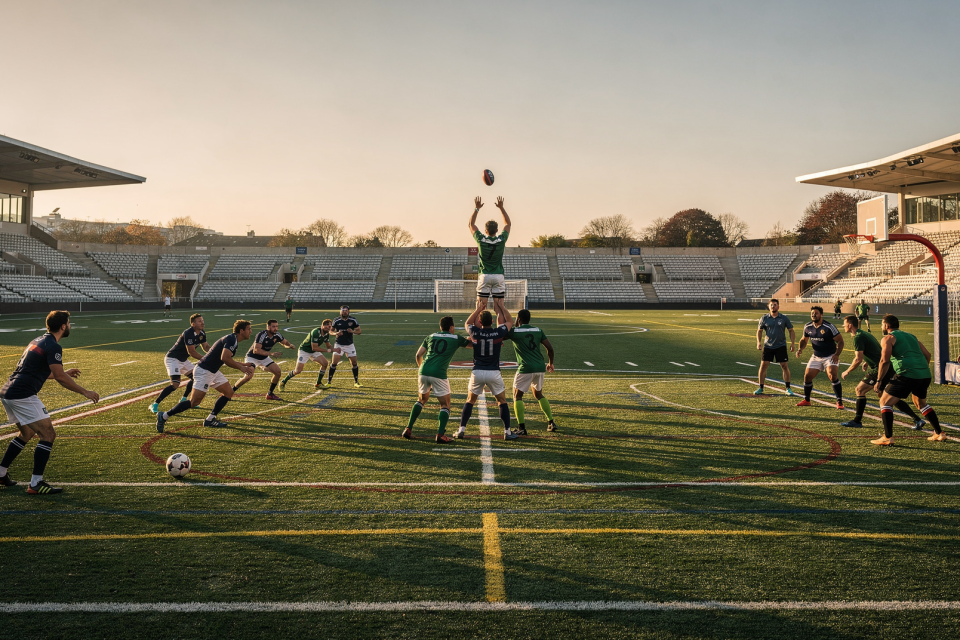
Most football fans have heard a pundit say a side showed “great line speed,” or that a pressing trap was “set beautifully on the touchline.” The phrases feel natural, almost instinctive, yet they didn’t originate on a football pitch. Scratch the surface of modern pressing vocabulary and you’ll find a borrowed language — one shaped by decades of rugby thinking about space, pressure, and collective movement. Once you see that connection, the tactical chatter around Premier League and Championship games becomes richer, more precise, and far more revealing.
Why rugby’s ideas map so neatly onto football pressing
On the surface, rugby and football couldn’t look more different — one dominated by continuous possession chains and individual receiving angles, the other by repeated collisions and restarts. But both codes grapple with the same fundamental challenge: how to force mistakes by controlling where and when an opponent can act. Rugby’s influence on football pressing language comes from that shared logic, not from a superficial attempt to sound tough.
The real transfer is conceptual. In rugby, coaches have always spoken about denying territory, compressing space, accelerating defensive movement, and organising the entire unit around the moment of contact or breakdown. Football analysts, especially in the UK, have slowly adopted a parallel set of terms to describe how teams close passing lanes, swarm the ball carrier, and lock opponents into predictable exits. That’s why words like pressure, trap, line, fold, and transition feel so at home in football analysis. They aren’t just verbs; they encode a way of seeing the pitch as a territory to be shrunk and controlled.
This matters immensely because pressing isn’t simply running hard at the ball. It’s a coordinated attempt to sculpt the opponent’s options before a pass is even received — a kind of anticipatory geometry. Rugby has been fluent in that anticipatory thinking for generations. Football has increasingly borrowed the vocabulary to explain its own, more fluid version of the same idea. When you hear a coach talk about “folding after the first press” or “locking the middle,” you’re hearing that cross-sport lineage in action.
The shared tactical problem: space, time, and decision-making
Both sports reward the side that narrows the opponent’s options fastest. In rugby, defenders try to close down angles and win collisions on their own terms, forcing an error or a slow recycle. In football, the equivalent is forcing a rushed pass into a crowded zone, a heavy first touch under pressure, or a hopeless long clearance that merely hands possession back. The specific actions differ — there’s no ruck in football, no offside line quite the same way — but the tactical aim is identical: degrade the quality of the next decision.
That’s why rugby’s terminology often sounds more overtly physical than football’s own jargon. Analysts reach for it when they want to emphasise urgency, directional control, and the collective weight of a unit moving as one, rather than individual chasing. “Press” sounds active; “trap” sounds deliberate and planned; “line” suggests synchronised movement, not a series of isolated efforts. Those nuances are critical because modern pressing is measured in structure, not distance covered. A high press without coordinated stepping is just a forward running by himself.
Think of it this way: rugby tends to describe pressure as a team shape that moves toward the ball, collapsing around the point of contest. Football often describes it as a sequence of triggers — a poor touch, a square pass, a backwards-facing receiver — that turn that shape into action. The overlap between the two approaches is large, and it’s precisely that overlap that has shaped the vocabulary analysts now use daily. The table below captures the most direct conceptual parallels.
| Rugby concept | Football pressing equivalent | What the language captures |
|---|---|---|
| Denying territory | High press / field tilt | Winning ground and pinning the opponent back, forcing them to play in areas they’d rather avoid. |
| Closing the breakdown | Compressing central space | Preventing clean progression through the middle third by squeezing the central passing lanes. |
| Line speed | Aggressive defensive stepping | Advancing together to reduce time on the ball, hurrying the opponent’s next action. |
| Folding after contact | Counter-press / rest defence reset | Recovering shape immediately after possession changes, ensuring the team isn’t exposed during transition. |
| Traps around the touchline | Sideline pressing traps | Steering opponents into limited exits — using the sideline as an extra defender. |
Which rugby ideas changed football’s pressing vocabulary most
The biggest influence doesn’t come from a single term; it comes from rugby’s deep-rooted obsession with coordinated movement around a contest. Football borrowed not only specific words, but the far more valuable habit of describing pressure as a system — a collective machine — rather than a collection of individual duels. This shift in mindset allowed analysts to explain why a team can press brilliantly even without winning the ball immediately, simply by disrupting rhythm and forcing the opponent into sterile territory.
The clearest imports are line speed, folding, traps, and phase control. These terms are especially prominent in UK commentary and tactical writing because they echo the way British and Irish rugby has framed defensive organisation for decades. In football, they help clarify why a well-structured press can feel suffocating even when the defending side makes very few tackles.
Pressing language also became more rugby-like as football analysis matured. A decade ago, television pundits relied on broad labels such as “work rate” or “closing down.” Modern tactical commentary demands finer distinctions: Is the team pressing centrally or outward? Is the trigger a poor first touch from a centre-back? Is the full-back stepping high while the centre-back covers the space behind? Rugby-style language answers those questions with the precision that serious analysts now expect. It turns vague effort into measurable, coachable behaviour.
Line speed: the cleanest example of rugby’s influence
Line speed is the rugby import that has travelled furthest into football’s everyday tactical vocabulary. In rugby union, it means defenders advancing quickly and in unison to cut down the attacking side’s time and space before contact. In football, the term now describes the same collective movement, most often when a back line or midfield unit steps up aggressively to compress the opponent’s build-up play.
The appeal is instant. “Line speed” says far more than “they pressed high.” It tells you the team moved as a unit, moved early, and moved with intent to make the opponent play before they had fully organised themselves. That’s tactically richer language, and it’s exactly why analysts at every level love using it.
It also changes how viewers perceive a press. A high block can look passive, almost inviting, if the team merely holds its line and waits for the ball to arrive. A high block with genuine line speed looks alive — a controlled wave bearing down on the man in possession. Rugby gave football a word for that difference, and once you’ve seen a side like Leeds United under Marcelo Bielsa or Liverpool at their peak, you can’t unsee it. The line moving as one becomes the story, not just the tackle that might follow.
Traps, channels, and the touchline as a defender
Another powerful borrowing is the idea of a trap. Rugby analysis frequently discusses channelling an opponent into a predetermined weak area, then compressing space there until an error is forced or the ball is pinched. Football pressing has adopted the same logic with almost geometric enthusiasm, especially when using the sideline as an extra defender.
In practice, this means coaches deliberately force the ball wide — often by showing the opposition centre-back the outside pass — before a midfield player arcs his run to block the return ball inside. Suddenly, the ball carrier has only one realistic option: play down the line under pressure. That’s a pressing trap. It’s not identical to what happens in rugby, but the principle is reassuringly familiar: limit the menu of safe options, shape the next action, and make the pitch feel half its real size.
The touchline plays a starring role here. In football, it acts as a free defender, denying the attacker a full 360-degree radius of escape. Rugby has long used the sideline as a pressure tool — kick to corner, chase, force the lineout — and the language of trapping an opponent near it transfers beautifully. Once that framing took hold, “pressing trap” became one of the most useful phrases in any analyst’s tactical vocabulary, instantly conveying a mixture of trigger, direction, and intended outcome.
Folding, shifting, and the language of recovery
Rugby also profoundly influenced the vocabulary around what happens after the first defensive action. In football, the word counter-press now dominates, but the older, deeper rugby idea is similar: if that initial pressure doesn’t win the ball, the team must recover its shape immediately and prepare for the next contest — no pause, no lingering.
That’s where terms like folding and shifting prove invaluable. They describe the repeated, almost wave-like defensive movements that keep the unit connected. In football, this becomes essential the moment the opponent plays through the press. One midfielder jumps, the full-back covers, a centre-back slides across, and the far-side winger drops to tuck in. The language used to explain that chain of recovery often sounds borrowed from rugby precisely because the underlying behaviour is so alike — rapid realignment around a new point of pressure.
For young players and fans learning to read the game, this language is a gift. “Folding” explains more than just retreat. It explains re-forming the structure around the ball, staying compact, and still hunting the next opportunity to steal possession. It’s a more active, more intentional word than “dropping off,” and it implies a team that is still controlling the situation, not merely surviving a wave of attacks.
How rugby changed the way football analysts describe pressing
Rugby didn’t just sprinkle a few fashionable terms onto the football lexicon. It altered the tone of analysis by making it more relational, more spatial, and far more collective. Where old-style football writing used to moralise — hard-working teams pressed, lazy ones didn’t — rugby encouraged a technical vocabulary that asks better questions.
Instead of debating whether a side “wanted it more,” the modern analyst asks where the first press begins, how the back line supports it, and which passing lane is being deliberately surrendered to gain an advantage elsewhere. That shift represents a huge improvement in the way we discuss the game, because it turns pressing into a set of observable, coachable decisions rather than a character test. Rugby, with its long tradition of breaking down defensive systems, gave football a template for that more mature conversation.
One of the most important cultural shifts has been the acceptance that a press can succeed without winning the ball. Rugby fans have always understood that territory gained, momentum checked, or a defensive shape protected can be a victory in itself. Football borrowed that idea as its own tactical culture deepened, and it liberated analysts to praise forced long balls, rushed clearances, and disrupted build-ups as genuine outcomes of effective pressing — not just consolation for a lack of interceptions.
A subtler but equally meaningful change is the rise of the collective noun. Football pressing talk increasingly favours phrases like “the unit steps,” “the line shifts,” and “the block moves.” Rugby has been speaking that way comfortably for decades, treating the defensive team as a single entity with linked, interdependent parts. That mindset is now central to how the best analysts in the UK break down a pressing sequence, because it captures what eleven individuals acting in sync can achieve.
Why UK football adopted the language faster than some other markets
The speed of adoption in the UK isn’t an accident. Football culture here sits remarkably close to rugby culture — they share media ecosystems, coaching language, and a fan base that often follows both sports. That overlap created a ready-made bridge for terminology to cross over without ever sounding foreign.
British punditry has always gravitated toward practical, vivid language that feels grounded in real physical play. Rugby gives it exactly that: phrases that are visceral, easy to imagine on the pitch, and rich with tactical meaning. When a commentator says a football side showed “line speed” or “folded poorly after the first press,” the audience can picture the movement instantly — even if they’ve never watched a rugby match in their life. The words do the work.
There’s also a structural coaching reason behind the trend. Across the UK, many performance departments share analytic habits across sports, and concepts like spacing, movement synchronisation, and coordinated pressure are much easier to compare when the language is already similar. Rugby has acted as a cultural and tactical bridge, helping coaches and analysts speak a common dialect whether they’re working with a round ball or an oval one.
What football gains and loses when it borrows rugby language
Any borrowing comes with a trade-off. Football gains precision and a richer structural vocabulary, but it can lose some of its own distinctive texture if rugby metaphors are stretched too far. The best analysts know when the borrowed term illuminates the action and when it starts to obscure the very football-specific details that matter most.
The major gain is clarity around structure. Rugby language helps explain that pressing isn’t a form of wild enthusiasm — it’s a planned movement system. It also gives analysts sharper ways to describe the critical beat just before a duel, the moment when a press either clicks or fractures. That half-second is where matches are decided, and having the right words for it matters.
But there’s a risk of overextension. Not every football press resembles a rugby-like collision of organised bodies. Football features more continuous possession chains, more recovery runs, and far greater emphasis on individual receiving angles and cover shadows. If every defensive action is crammed into a rugby lens, the subtleties of the football-specific action disappear. A sharp tactical writer uses the comparison to sharpen understanding, not to flatten two distinct sports into one.
Another limitation is audience familiarity. UK readers may nod along comfortably with rugby-inflected phrases, but international football audiences may find them confusing or even misleading. That’s not trivial for clubs, broadcasters, and publications aiming at a global readership. The language must stay precise enough to travel without a glossary.
| Benefit of rugby-style pressing language | Potential drawback | Best use case |
|---|---|---|
| Explains coordinated defensive movement as a single unit. | Can sound too physical for some football situations, missing the nuance of receiving angles. | Analysing high presses and compact blocks where shape is key. |
| Makes traps and line shifts easier to visualise for the audience. | May blur football-specific details like passing and receiving body orientation. | Tactical columns and coaching breakdowns with clear examples. |
| Emphasises collective responsibility over individual heroics. | Can overstate the similarity between sports, pushing the metaphor too far. | Comparative analysis and broadcast commentary. |
| Adds a sharper spatial vocabulary for territory and control. | May confuse readers unfamiliar with rugby terminology. | Long-form explanation with visuals or worked examples. |
A practical way to use the comparison without forcing it
The most effective method is to treat rugby as a useful reference point, not a rigid template. Start by asking what the football team is specifically trying to remove from the opponent: central access, a wide release, or simply time to turn and face forward. Then see whether rugby-style language helps describe that action with more clarity than football’s own vocabulary.
For instance, if a team presses to shut down the holding midfielder and force play into wide areas, “trap” and “line speed” are excellent terms — they capture the deliberate funneling and the coordinated advance. If the phase is all about instant recovery after a turnover, “fold” can convey the urgency of re-forming shape. But if the issue is merely poor distance between lines, football’s own words — compactness, spacing, coverage — may be more precise. In short, the best terminology is whatever explains the mechanism fastest, without needing a footnote.
That approach keeps analysis disciplined and avoids the common trap of using fancy language to project authority without actually clarifying the action. Good tactical writing is always about revealing the sport, not the thesaurus.
Common mistakes when talking about rugby influence on football pressing
Seeing the link between the two sports is valuable, but it’s easy to push the analogy too far. Here are the most frequent missteps — and how to dodge them.
- Using rugby terms as decoration rather than explanation. Dropping in “line speed” or “collision area” without tying them to a specific tactical moment creates noise, not insight. The term must earn its place by making something visible that would otherwise be missed.
- Calling every aggressive press “line speed” even when the line doesn’t advance together. If the centre-back steps while the full-back holds still, that’s not line speed — it’s a disjointed action. Precision matters.
- Treating a press as successful only if the ball is won. This ignores rugby’s most valuable lesson: forcing a panicked clearance, slowing progression by two seconds, or channelling play to a weaker ball-player are all meaningful wins. Measure the effect, not just the outcome.
- Ignoring football-specific details such as cover shadows, receiving body shape, and second-ball positioning. A pressing trap might work because a midfielder’s curved run blocks the passing lane, not because of raw physical pressure. Never let rugby language wash out the football nuance.
- Mixing rugby and football terminology in the same sentence without clarifying the tactical point. Phrases like “they folded around the breakdown after the counter-press” can confuse everyone. Keep the language clean and functional.
What this means for coaches, analysts, and serious fans
For coaches, rugby’s influence offers a sharper vocabulary for teaching collective movement — a way to communicate the “why” behind coordinated stepping and recovery runs without falling back on clichés about desire. For analysts, it provides a precise set of concepts to describe pressure as a layered system rather than a single action. And for fans, it makes pressing far easier to read in real time because the words are more visual, more physical, and more directly tied to what the bodies on the pitch are actually doing.
The practical value is simple and immediate. When watching a match, focus on three things: how quickly the first presser arrives, whether the supporting players move together as a connected line, and which exit route the defending side appears to be deliberately blocking. Those three questions capture the majority of the rugby-to-football crossover in pressing language, and they’ll transform the way you see both sides of the ball.
Ultimately, the comparison becomes genuinely useful when it reminds football observers that defensive success is often about steering, not sprinting. It’s about making an opponent choose the wrong option before the contest becomes visible on the screen. That’s why rugby’s influence on football’s pressing language has endured: it names the invisible, spatial work that decides so many modern matches. If you’re writing a tactical column or coaching report, the safest rule is straightforward — use rugby language when it improves spatial understanding, and drop it when football already has the better, cleaner word. That balance produces stronger analysis, more honest coaching insight, and none of the jargon-for-its-own-sake that clogs up so much tactical writing.
FAQ
Why does football use rugby terms in pressing analysis? Football uses rugby terms because both sports rely on organised pressure, spatial control, and coordinated movement. Rugby had already developed a rich, precise vocabulary for describing those ideas, and football analysts adopted it because it captures the collective nature of pressing better than older, vaguer terms like “closing down.”
Is “line speed” originally a rugby term? Yes, it comes directly from rugby defensive language, where it describes defenders advancing quickly and together to reduce the attacking side’s time and space. In football, it now describes the same principle, most commonly applied to a back line or midfield unit stepping up in unison.
What is the most common rugby influence on football pressing language? The most common influence is the idea of the trap: forcing play into a narrow, pre-planned area — usually near the touchline — and then compressing space so the opponent has very few safe passing options. This concept is now fundamental to how pressing systems are designed and explained.
Does rugby actually influence how football coaches think? In some cases, yes. The influence is strongest at the level of tactical language and defensive principles, particularly around collective movement, spacing, and the organisation of pressure after turnovers. Many coaches find rugby’s systemic view of defence a helpful mental model, even if the on-pitch execution is entirely football-specific.
Is rugby language always better for describing pressing? No. Rugby language is most useful when it clarifies structure or spatial control. But football-specific terms are often better for describing passing angles, cover shadows, receiving body shape, and the finer details of build-up play. Good analysts know when to borrow and when to stick to native vocabulary.
Why is this comparison especially common in the UK? Because UK sports media and coaching culture are comfortable with rugby-style physical and spatial terminology. The two sports share audiences and, increasingly, analytical methods. That cultural closeness allows rugby terms to enter football language without feeling forced, and it explains why British broadcast commentary leans on them so heavily.