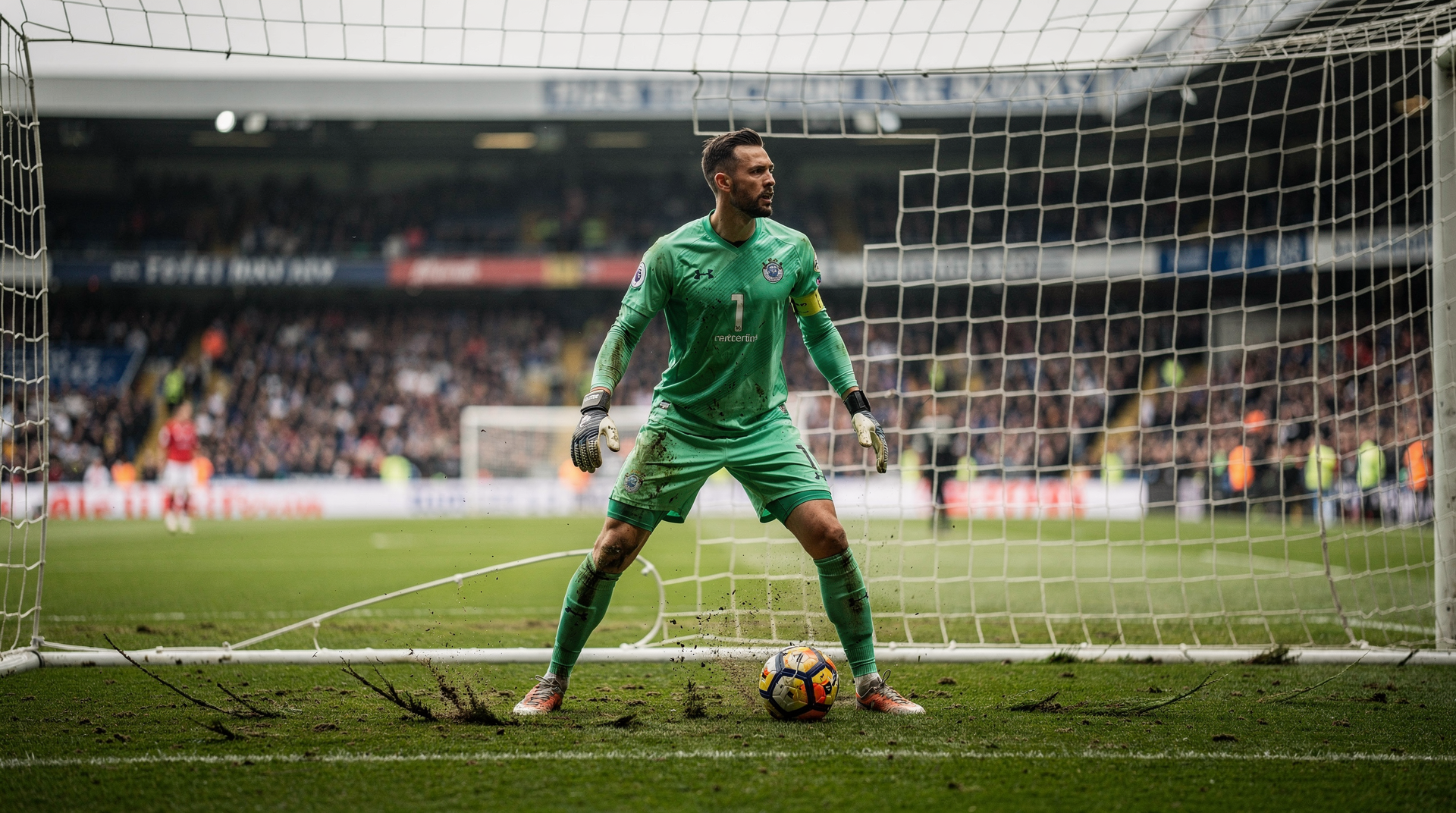
A single goalkeeper can explain an entire Championship season more faithfully than a dozen scorelines ever could. In a division where pressure is the only constant and the margins are brutally fine, the choices a shot-stopper makes between the posts often spell out a club’s identity, its hidden fragilities, and the true shape of its ambition. This isn’t about clean sheets or highlight reels—it’s about how one player’s season can carry the full weight of a campaign.
Why one goalkeeper can define a Championship story
A goalkeeper defines a Championship story because the position sits at the precise intersection of tactics, psychology, and pure survival. In a league where momentum swings violently and no lead feels safe, the keeper becomes the clearest mirror of what a team actually is—not what the manager hopes it might be, or what the table pretends it has been.
That reality bites hardest in the Championship because the football is never tidy for long. Opponents press high and force rushed clearances; possession gets recycled poorly under pressure; and goalkeepers are tested by a relentless barrage of direct balls, set-piece scrambles, and second-phase chaos. A keeper’s value, therefore, extends far beyond the saves he makes. It lives in how he commands his area, how he distributes under duress, where he positions himself before the shot is even struck, and—crucially—how calmly he helps his side navigate the storm. For a team chasing promotion or fighting the drop, those details often determine whether a season feels like a controlled project or a slow-motion crisis.
The most revealing stories don’t emerge from tallying clean sheets and goals conceded. They come from watching how the goalkeeper’s presence rewires the behaviour of everyone in front of him. Did the centre-backs start holding a higher line because they trusted him to sweep behind? Did the midfielders press more aggressively knowing that one misplaced pass no longer meant certain disaster? Did the manager abandon a short build-up because the keeper simply couldn’t function as an extra outfield player? These questions turn a routine match report into a proper athlete profile, one that captures the invisible architecture of a team.
One reason goalkeeper-led narratives work so powerfully in football journalism is that they fuse the visible and the hidden layers of the game. The diving save is obvious. What’s less obvious—and often far more significant—is the positioning that prevented the shot, the shouted instruction that killed a counter-attack, or the quick distribution that launched the next attacking phase. That’s where the real story breathes.
| Lens | What to look for | Why it matters in the Championship |
|---|---|---|
| Shot-stopping | Reaction saves, one-on-ones, handling under pressure | Matches are decided by narrow margins and repeated box entries |
| Command | Crosses, set pieces, defensive organisation | Direct play and dead balls are constant threats |
| Distribution | Long passes, short build-up, release under pressure | Press resistance can fundamentally alter a team’s structure |
| Psychology | Response after mistakes, body language, communication | Momentum shifts quickly in a long, punishing season |
A Championship goalkeeper story becomes genuinely powerful when it weaves those four layers into a single, coherent arc. That arc is what stays with the reader, because it explains not just what happened but why the entire season felt the way it did—why a club’s promotion push gathered an unstoppable rhythm, or why a mid-table side quietly imploded under the weight of its own uncertainty.
How to read a goalkeeper beyond the save count
To understand a goalkeeper properly, you have to study his decision-making rather than just the highlights. Save totals matter, of course, but they’re only one brushstroke in a much larger picture.
The laziest mistake in football writing is treating every save as equal. In reality, a routine catch in the 89th minute when your team is three goals up is not remotely comparable to a reflex stop that preserves a one-goal lead after a defensive meltdown. Nor is a keeper who faces twelve shots under siege the same as one who sees three tame efforts all afternoon while his back line does the real work. The Championship punishes shallow analysis precisely because the same goalkeeper can look outstanding in one tactical set-up and utterly exposed in another.
A sharper approach is to break performance down into five practical questions. Was the goalkeeper set early enough to deal with quick changes of angle? Did he manage his starting position to narrow the goal effectively? Did he claim enough high balls to relieve pressure on the defence? Was his distribution actively helping the team build play, or merely returning possession to the opposition? And, critically, did his errors—every keeper makes them—create a ripple of instability elsewhere?
These questions yield a far more honest read on form. For example, a keeper might post a pedestrian save percentage but still be indispensable if he repeatedly bails his team out of set-piece chaos and allows the back four to push higher with confidence. Another keeper might rack up impressive numbers while actually hurting the team’s build-up by forcing defenders into conservative, backwards passes that invite pressure. In a league as relentlessly transitional as the Championship, that difference is colossal.
There’s also a psychological dimension that’s easy to overlook. A goalkeeper often determines how brave the rest of the team dares to be. A defence that trusts its keeper can defend on the front foot, squeeze the pitch, and take calculated risks in possession. A defence that doesn’t drops deeper, clears the ball earlier, and turns every phase into a grim survival exercise. That’s why any keeper profile worth its salt must be written in relation to the team, not as a collection of isolated statistics.
A practical way to assess a goalkeeper over the long haul of a season is to watch for patterns rather than incidents. One mistake is noise. Three similar mistakes, in comparable situations, form a theme. The same logic applies to excellence. A keeper who repeatedly smothers low crosses, attacks first balls, and resets the team’s shape calmly after losing possession isn’t simply “in good form”; he’s performing a specific, vital tactical function that may be the single reason his club is still alive in the table.
- Check whether the goalkeeper is saving high-value chances or mostly routine shots.
- Watch how often he prevents danger before the shot is even taken.
- Compare his distribution choices under intense pressure with those in calmer phases.
- Note whether his communication visibly improves the shape of the defensive line.
- Track whether the team’s entire structure changes when he is unavailable.
These habits stop analysis from becoming lazy. In athlete-profile writing, that precision is what turns a collection of opinions into a credible, lasting narrative.
The tactical role: what a Championship goalkeeper really does
A Championship goalkeeper is far more than the last line of defence. He’s a tactical stabiliser, an organiser, and—in many systems—the first passer of an attacking move. His role shifts depending on whether the team wants control, directness, or sheer survival.
That tactical flexibility is precisely why the position becomes so revealing in a feature piece. In a possession-heavy side, the keeper has to support the first phase of build-up, receive under pressure, and help create overloads against the press. In a more direct outfit, he may be asked to launch attacks quickly and accurately, turning defensive clearances into immediate territory. In a deep-block, low-percentage side, he becomes a traffic controller, managing crosses, second balls, and the emotional panic that builds with every wave of opposition pressure.
The Championship amplifies all of this because most clubs simply don’t have the luxury of playing one uniform style every week. Opponents vary wildly—from possession purists to long-ball battering rams—the pitches can be unforgiving, and fixture congestion leaves almost no time to reset tactically. A keeper who can adjust across those contexts gives his manager options that never show up in a post-match report. That’s why the best long-form profiles always explain the system as well as the individual caught inside it.
| Tactical demand | What it looks like in practice | Effect on the team |
|---|---|---|
| Build-up support | Short passes to centre-backs, calm under the press | Helps the side play through pressure |
| Direct release | Accurate long kicks to wide or central targets | Turns defence into attack in an instant |
| Cross management | Timing claims, punch decisions, traffic control | Reduces second-phase danger |
| Sweeper action | Moving off the line to intercept through balls | Allows the defence to play higher and squeeze space |
| Game management | Slowing tempo, calming teammates, resetting shape | Protects leads and neutralises chaos |
The most compelling Championship goalkeeper stories usually surface when a team’s tactical needs shift midway through a season. Early on, the keeper might be asked to play aggressively from the back. Later, if results sour, the manager may scrap that plan and demand safer distribution. A profile built around that arc becomes more than a player feature—it becomes a portrait of adaptation under fire.
There’s a useful editorial trick I’ve learned: describe the goalkeeper through the decisions he forces other people to make. If defenders stop splitting wide because they don’t trust his passing angle, that’s a tactical story. If midfielders begin dropping deeper to offer safer outlets, that’s a tactical story. If the manager alters the pressing scheme because the keeper handles one-vs-one situations superbly, that, too, is a tactical story. The best athlete profiles show that football is fundamentally relational—every choice is a thread in a larger fabric.
What makes the story feel human
The most memorable goalkeeper profiles are never purely technical. They’re emotional, because goalkeepers live with consequences that are brutally visible. One goal can define an entire week. One mistake can haunt a player far longer than the dozen saves that came before it.
That pressure gives the position a natural narrative shape, full of doubt, recovery, and quiet reinvention. In the Championship, where clubs operate under weekly strain and the margin for error is wafer-thin, that emotional load becomes part of a keeper’s sporting identity. Readers connect with it because they instinctively understand what it means to perform while knowing that success may go unnoticed and failure will be replayed endlessly on highlight shows and social media.
The human angle often comes from the mundane, repetitive details. How does the goalkeeper prepare for crosses after a difficult match? Does he respond to public criticism by becoming more conservative, or does he double down on his attacking instincts? How does he communicate when the back line is young, newly assembled, or simply unsettled? These details turn a profile into a story about resilience rather than just performance.
Another fruitful angle is the gap between reputation and reality. Some goalkeepers build a public image as fearless leaders, only for the data and the tactical context to reveal a far more complex, occasionally vulnerable player. Others appear understated, even forgettable, until the system collapses without them and everyone realises what they’d been quietly holding together. That tension creates genuine narrative movement and prevents the article from reading like a sanitised tribute.
A good Championship feature should show the keeper in motion, never frozen into a convenient label. Perhaps he arrived as a backup and became indispensable. Perhaps he was written off after a shaky start and then gradually settled a defence that had been leaking chances for months. Perhaps he’s still learning his craft, but his decision-making has improved enough to raise the team’s ceiling. Those arcs feel earned, and they’re far more powerful than any generic praise.
It also helps to include small, telling moments. A full-stretch dive after a deflected shot. A quiet fist pump after a defended set piece. A slow, deliberate walk to the edge of the area when the crowd’s nerves start crackling. These details aren’t decoration; they’re evidence of mood. In sports writing, mood is often the difference between sterile information and genuine atmosphere.
How to structure a goalkeeper-led Championship feature
A goalkeeper-led feature works best when it moves from a specific, gripping moment to the wider season arc. Open with the defining image, then widen the lens to show why it matters. This structure keeps the piece readable while still granting it the depth a serious analysis demands.
The opening should never simply announce that the goalkeeper is important. Instead, place the reader inside a moment that captures his entire season. A stoppage-time save that preserved a crucial point, a nervy distribution sequence under a high press, a dominant command of the box that seemed to settle everyone around him, or a match where the whole team visibly breathed differently because of his presence—any of these can work as an entry point. Once that hook is set, the article can expand into context: the club’s ambitions, the tactical set-up, and the relentless pressures of the campaign.
From there, the body of the piece should alternate between observation and explanation. Describe what the goalkeeper did, then unpack what it meant. That rhythm keeps the narrative alive and helps avoid the common trap of filling athlete profiles with abstract admiration. Readers want to understand how the player affected results, not just that he was “reliable” or “important.”
| Section | Purpose | What it should answer |
|---|---|---|
| Opening scene | Establish the emotional hook | Why does this goalkeeper’s story matter right now? |
| Tactical context | Explain the team environment | What job was he actually being asked to do? |
| Season arc | Track development across months | How did his role, form, or reputation change? |
| Human layer | Add personality and pressure | What made the experience difficult or revealing? |
| Wider significance | Connect player to club story | What does his season say about the Championship as a whole? |
A useful writing discipline is to use each section to escalate the story rather than repeat it. The opening should be a snapshot. The next section should widen into tactics. The middle should introduce pressure, setbacks, or growth. The final section should show how the goalkeeper’s season reflects something larger—about the club, the division, or the very nature of high-stakes football.
Be meticulous with evidence. If the profile claims improvement, point to the concrete details that support it: cleaner handling, better timing off the line, more confident distribution, fewer panic clearances from defenders who now trust the man behind them. If it discusses decline, name the pattern rather than leaning on vague language. Strong features are built on visible proof, not mood alone.
Common mistakes to avoid
The easiest way to weaken a goalkeeper profile is to let it read like a match summary stretched too thin. Readers can sense when a piece has been assembled from recycled scorelines rather than genuine, layered analysis. Another frequent error is overusing generic adjectives—“brilliant,” “solid,” “underrated”—without ever showing the mechanics behind the judgment.
Structural problems also creep in. Some features spend too long on early-career background and arrive late to the actual story. Others describe the tactical system in detail but never connect it to the human being operating inside it. A stronger approach is to keep returning to the same central question: how did this goalkeeper shape the team’s season, and what does that reveal about the player as a competitor?
A clean editorial checklist helps:
- Anchor the feature in one defining match, moment, or sequence.
- Explain the tactical role before interpreting the emotional stakes.
- Use specific examples instead of broad praise.
- Show change over time, not just current form.
- Tie the player’s story back to the club’s larger Championship journey.
That’s the difference between a profile that informs and one that lingers. The first tells readers what happened. The second helps them understand why it mattered.
Why this kind of story fits the Championship so well
The Championship is made for this sort of narrative because it is a league of repetition, tension, and heavy consequence. Over 46 matches, the same themes return in different shapes, and goalkeepers sit right at the centre of that grinding, unpredictable rhythm.
That makes the position uniquely suited for long-form storytelling. A striker might oscillate between scoring streaks and lean spells. A midfielder might influence matches in ways that are maddeningly hard to capture in a quick summary. But a goalkeeper is involved in every defensive phase, every momentum swing, and every nervous pause before the next attack. He is one of the few players whose body of work can tell the story of a team from the first minute of August to the last gasp of May.
The position also exposes the league’s contradictions in a way few others can. Championship football is often described as raw or chaotic, yet good goalkeeping reveals how much quiet organisation is required simply to survive it. People talk about intensity, but a keeper’s story shows the value of patience. They talk about resilience, but a season in goal often demonstrates that resilience is built through countless repetitions, not motivational slogans. That’s why the best profiles in this space feel wider than the individual they describe.
A goalkeeper tale also connects naturally with readers who want more than headlines. That audience hungers for patterns, consequences, and deeper context. They want to understand how a club stayed alive in a promotion race or avoided disaster even when the football itself was deeply uneven. They want to see the human and tactical logic behind the result. A goalkeeper story delivers all of that in one concentrated form, because the position inherently carries both drama and structure.
There’s one more reason this approach works: it respects the reader’s intelligence. Rather than treating football as a stream of isolated events, it shows how one player’s decisions accumulate into the shape of an entire season. That’s a more satisfying way to read sport, and it’s especially suited to Championship coverage, where narratives are never tidy for long and the only certainty is that everything can flip in the space of two fixtures.
The strongest takeaway is deceptively simple. A goalkeeper is not only the final barrier between a shot and a goal; in the Championship, he is often the clearest lens through which to understand the team itself. When his season is told properly, the story becomes bigger than a position and sharper than any statistic. It becomes a portrait of pressure, control, and the fragile order that holds a campaign together.
In the end, a Championship tale told through one goalkeeper is really a story about how football works when every inch matters. The saves are the surface. The deeper story lies in the choices, the structure, and the temperament that sit beneath them. That’s where the real narrative begins, and it’s why I’ll always believe the goalkeeper is the most honest storyteller on the pitch.